
Great Book Review – THE REVENUE ACCELERATOR – The 21 Boosters to Launch Your Startup

Great Reviews – THE REVENUE ACCELERATOR

Inc., September 7, 2022, Martin Zwilling
“Many new business owners find the toughest hurdle to get over is not building an innovative solution, but selling it and exponentially scaling the business. To accelerate revenue and profit growth, you need innovative marketing strategies that go well beyond conventional advertising and distribution. I recommend you follow the principles outlined here to take the lead and hold it.” The Revenue Accelerator – The 21 Boosters to Launch Your Startup

Goodreads, September 27, 2022, Alexander’s Review
“It’s that mixture of brash, almost tough-talking confidence, along with genuinely objective knowledgeable passages that elevates this book. I felt like I was actually in good hands for once, rather than someone telling me how much I was so.”

Hollywood Digest, October 5, 2022, Garth Thomas
“He’s daring, uncompromising, and cuts through the white noise to present an almost overly concise view of how to succeed in business – particularly with the realization of one’s own enterprise – in the timeless echelons of workplace power.”

Also covered in StartupNation, Youngupstarts, CEOworld Magazine.

Book, Kindle, AudioCD at:

The Revenue Accelerator: The 21 Boosters to Launch Your Start-Up

amazon.com

5 MINUTES OR YOU ARE OUT THE DOOR

5 MINUTES OR YOU ARE OUT THE DOOR

One of my clients was an in-house labor counsel for a Fortune-500 company. She had been with a law firm for 10 years prior to her current job. Having made numerous pitches before starting her in-house position, she knew the type of research and approaches that would resonate.

Now, wearing a different hat, she found herself frustrated with how many outside vendors approached her, knowing nothing about their company’s products or competitors. She enforced a five-minute rule: If the salesperson did not demonstrate knowledge of their needs, challenges, and opportunities within the first five minutes of the meeting, out they went.

I asked her to tell me more about her rule. She was proud to say that the vendors who met with her learned the message quickly , and they “got right to it.” She found a similar rule was a useful tool among her own team as well.
Their meetings:
·       Got right to the point
·       Did not waste anyone’s time, and
·       Resulted in clear and concise decisions.

No alternative text description for this image

A

BUSINESS ETHICS? REALLY?? YES!

BUSINESS ETHICS? REALLY? YES!

Possessing a high standard of business ethics is an absolute requirement for successful entrepreneurs. Moral standards should steer your decisions. According to the American Marketing Association Statement of Ethics in 2014, all businesses should hold the following ethical values:

Honesty: be forthright in dealings with customers and stakeholders.

Responsibility: accept consequences for marketing decisions and strategies.

Fairness: balance justly the needs of the buyer with the interests of the seller.

Respect: acknowledge the basic human dignity of all stakeholders.

Transparency: create a spirit of openness in marketing operations.

Citizenship: fulfill the economic, legal, philanthropic, and societal responsibilities that serve stakeholders.        

WOMEN ENTREPRENEURSHIP REPORT

WOMEN ENTREPRENEURSHIP REPORT

We are moving in the right direction! In 2020, both the Women Entrepreneurship Report and the African American Women Entrepreneurship Report noted that investments for women and minority-owned businesses have gone up, with total capital increasing from $5,000,000 in 2016 to 35,000,000 in 2019.

The statistics in the Women Entrepreneurship Report also showed that women and minorities are actively sourcing funding as follows:
35.38% Finding and working with small business development centers.
34.38% Incubators.
34.38% Co-working spaces.
28.13% Business accelerators.

No alternative text description for this image

Activate to view larger image

YOUR LOGO IS NOT YOUR BRAND

YOUR BRAND IS NOT A LOGO

5 tips for a new startup to market and build it’s presence. A big hurtle I see often is making the leap from a new product to selling it.

My personal favorite is Number 2, branding. Your brand is not simply a logo, a brand is what describes you. It’s what people remember about you or your company after you leave the room.
#tipsforsuccess #branding #marketingadvice

BOOMERS TO Z’ERS

BOOMERS TO Z’ERS

It goes almost without saying that different groups interpret messages differently. Using the correct message channel requires careful preparation. Encoding a clear message is more complicated today because selling your product or service may be of interest to any of the four major generations currently vital and active in our world.

·       Baby Boomers: Born between 1946 and 1964, Boomers are a group with significant incomes who are looking for solutions in selecting products and services.
·       Gen Xers: Born between 1965 and 1977, Gen X is a smaller group than the Boomers. With their kids no longer their main focus, their tastes for products and services are in flux. Selling to them requires more detailed research on specific needs and concerns.
·       Millennials: Born between 1978 and 1994, Millennials are beginning to collect savings and they work well with technology. Concerned with costs, they spend more time analyzing purchasing options and waiting for sales or specials, and they want to see others successfully using a product or service before committing.
·       Gen Z: Those born since 1995 think and act online. They are “digital natives” and want to hear from you via text, call, Zoom, etc. As this group matures, they will have a greater impact on the economy and be in control of significant purchasing decisions.

Your product or service will require completely different sales approaches depending on which generation you’re marketing to. You may limit your targeting ultimately to only one or two of these groups. Spend time researching the survey data and demographic details of each group and take special note of their differences. These will impact how you tailor the need and use for your product to them.

No alternative text description for this image

Activate to view larger image

BUILD BUSINESS WITH DISTRIBUTION DEALS

BUILD BUSINESS WITH DISTRIBUTION DEALS

A major cost for many start-ups that develop physical products is storing and distributing their products. One shortcut to the market is establishing a relationship with a distributor who services your marketplace, otherwise known as a distribution deal. In the beginning, Made for Success was a two-person company operating a book publishing company out of a residential home. Lacking warehouse space and shipping infrastructure, the company didn’t have the essential infrastructure to expand.

The company started to research solutions and identified a distribution company called Ingram Publisher Services, a division of the world’s largest book distributors. Ingram, a multibillion-dollar company representing hundreds of mid-tier book publishers, created this solution to provide distribution and sales infrastructure.

Upon signing the deal, Made for Success instantly had access to five distribution centers domestically and three distribution centers internationally to store and sell books. The company could also print inventory in four countries across the globe, all integrated into complex operational infrastructure for storing, selling, and invoicing. Within a short period of time, Made for Success books were available globally. Otherwise, it would have cost the company millions of dollars to build out. In return for the distribution infrastructure, Ingram Publisher Services receives a percentage of the wholesale revenues from each book sold.

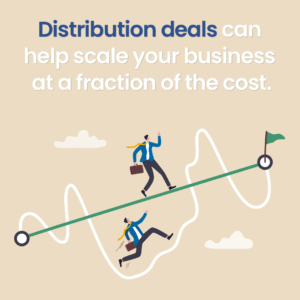
Distribution deals bring numerous advantages, including decreased time to market and access to infrastructure that is beyond the scale of a company like Made for Success. Odds are, if you operate a start-up, there are distributors in your industry who can help provide the ability to scale your business at a fraction of the cost of building it yourself.
Major Book Review

BOOK REVIEW
Goodreads.com

The Revenue Accelerator Lib/E: The 21 Boosters to Launch Your Start-Up
by Allan Colman

Alexander’s review
Sep 21, 2022

Dr. Allan Colman knows of what he speaks. There’s a sense of appropriate, professional and self-assuredness with the tonality of his new work, The Revenue Accelerator: The 21 Boosters to Launch Your Startup. “I was never taught how to sell. But by going through the struggles, obstacles, roadblocks, challenges, wrong turns, and searching for real opportunities, my self-education took hold. I wrote 21 Accelerators To Launch Your Start-Up to help you avoid many of the problems start-up entrepreneurs experience in making the leap from building their product or service to selling it,” he writes at the beginning of the book. “…I (craft) my pitch meetings much more carefully, and the 50 speeches I was doing annually for several years focused on problem solving and benefits. These and many other lessons are incorporated into this book to make your transition from building the product/service to successfully selling it.” Fair enough, and the read does just that. The Revenue Accelerator sort of feels like the Ask Jeeves of startup advice manuals, and overall business and leadership advice books in general. It’s clear Dr. Colman wants to create something that is essentially the penultimate guide to success, and he himself succeeds in this endeavor on more than one occasion. The read is broken down into densely detailed chapters, all of which are packed to the brim with information respective to their select subtopics. Each one of these subtopics are called, in titular style, Accelerators. Colman is also not afraid of making things personal. He writes in vivid detail about his own experiences climbing the corporate ladder, unafraid to humbly admit mistakes made in the process.

………………………………….

It’s that mixture of brash, almost tough-talking confidence, along with genuinely objective, knowledgable passages that elevates the book. I felt like I was actually in good hands for once, rather than someone telling me how much I was so.
1 like · Like ∙ flag

Goodreads

Know Thy Client

Know Thy Client!

Knowing how their business / organization works is critical before pursuing them for new business. You and your colleagues should ask and answer the following questions before you begin to pursue current, recent, or prospective clients.

Who is the decision-maker?
What other firms/companies are they using now?
When was the last time they hired a new firm or purchased a new product?
Do they prefer to communicate by phone or email?
What have you done recently to build a relationship with them?
Have you asked ahead of time who else will be attending the meeting?
Do you offer periodic review meetings regarding budgets, billing, timelines for the engagement process, and report format?
Do you know their pain?
How will financial decisions be made?

Listen, Listen, Listen


Next to your “takeaway” message, the art of listening is the most important, effective tool in a pitch meeting. If you combine a frequent, powerful takeaway message along with strong listening skills, you will open up a major passage to gain new business.

IBM recommends letting your customers, clients, and prospects talk 60% of the time. Letting your clients talk more than you gives you the chance to formulate questions that best yield what their needs are. You then have the opportunity to demonstrate how best to address their needs with the benefits and solutions you have to offer.
Here are five key pre-meeting research questions:

Who are their competitors? Look at their industry, their products, or their services. Evaluate tax laws or legislation that might impact them.
What is their business? Understand what your prospect actually produces, how they sell it, what type of marketing they use, their management structure, etc.
What are their buying habits? Who makes the final decisions, and are they “hidden” decision-makers?
What keeps them up at night? What are their pain points?
What benefits and solutions are they looking for?

Building answers to these questions is a necessary skill in order to fully relate and understand their needs and how you address them. Remember: Good questions sell better than good answers.

No alternative text description for this image

Activate to view larger image